
3 Lines of Defense for AI Governance
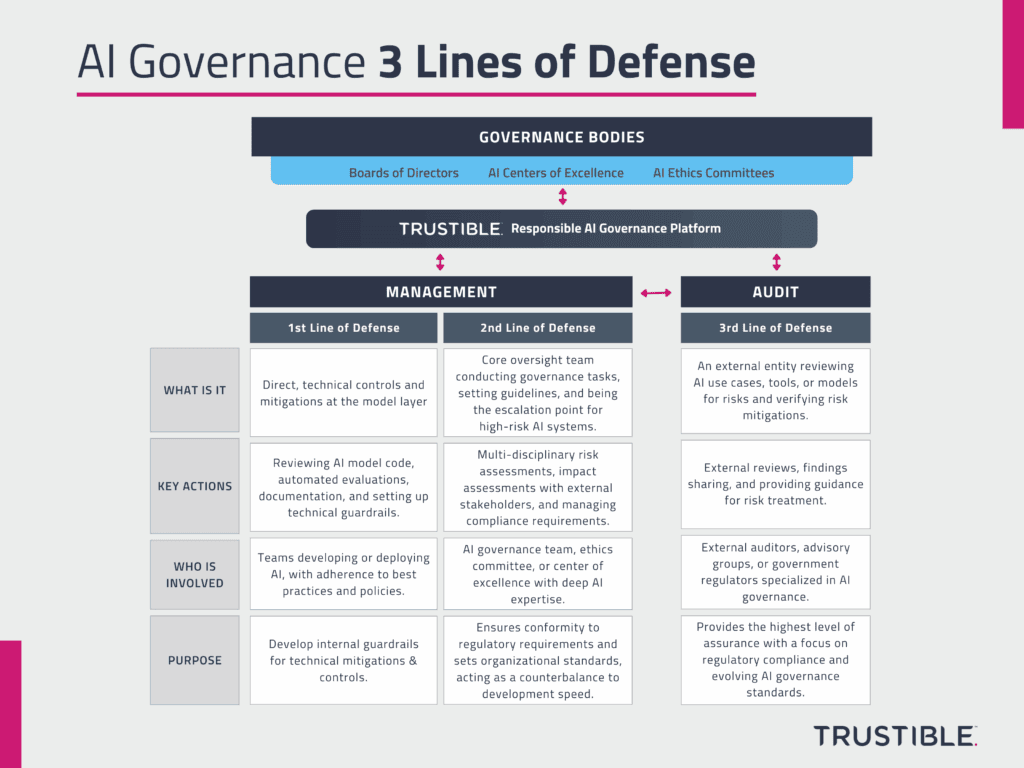
AI Governance is a complex task as it involves multiple teams across an organization, working to understand and evaluate the risks of dozens of AI use cases, and managing highly complex models with deep supply chains. On top of the organizational and technical complexity, AI can be used for a wide range of purposes, some of which are relatively safe (e.g. email spam filter), while others pose serious risks (e.g. medical recommendation system). Organizations want to be responsible with their AI use, but struggle to balance innovation and adoption of AI for low risk uses, with oversight and risk management for high risk uses. To manage this, organizations need to adopt a multi-tiered governance approach in order to allow for easy, safe experimentation from development teams, with clear escalation points for riskier uses.
How State Executive Orders are Shaping U.S. AI Policy
States continue to pave the way forward on AI policy. As we have previously discussed, 2023 saw a flurry of activity from state legislatures on various AI-related legislation. However, state legislatures were not alone in attempts to implement greater oversight for AI technologies. Over the past year, the Governors of California, Maryland, New Jersey, Oregon, […]
Operationalizing AI Governance in Insurance
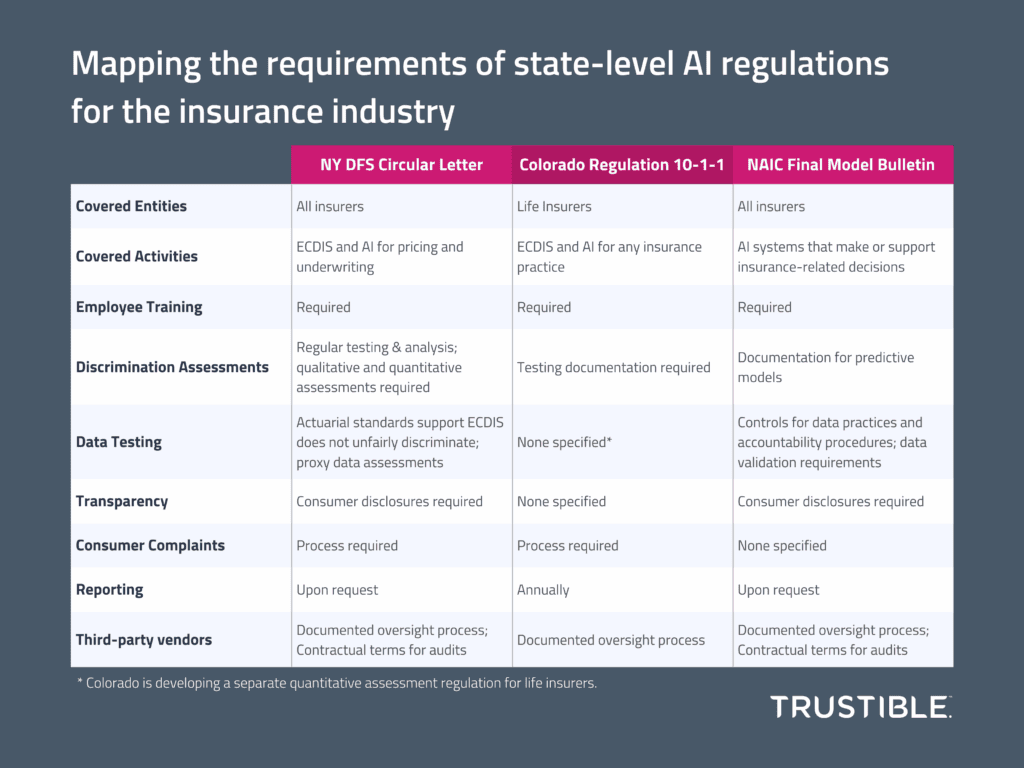
Federal regulators have largely focused on issuing guidance and initiating inquiries into AI, whereas state regulators have taken a more proactive stance, addressing AI’s unique challenges within sectors such as insurance. The New York Department of Financial Services released a draft guidance letter proposing standards for identifying, measuring, and mitigation potential bias from use of […]
An Applied Ethical AI Framework
In our new white paper, we discuss how AI governance professionals, and their organizations, can apply an actionable and flexible framework for evaluating ethical decisions for AI systems. Many organizations talk about Ethical AI, but many struggle to define it clearly. They often settle on sets of high level principles or values, but then struggle […]
Product Launch: Introducing ISO 42001
Today, we’re excited to announce that we are now offering customers access to ISO 42001 Standard within the Trustible platform – becoming the first AI governance company to offer the standard on its platform. ISO 42001 is positioned to be the first global auditable standard designed to foster trustworthiness in AI systems by setting a […]
Is it AI? How different laws & frameworks define AI
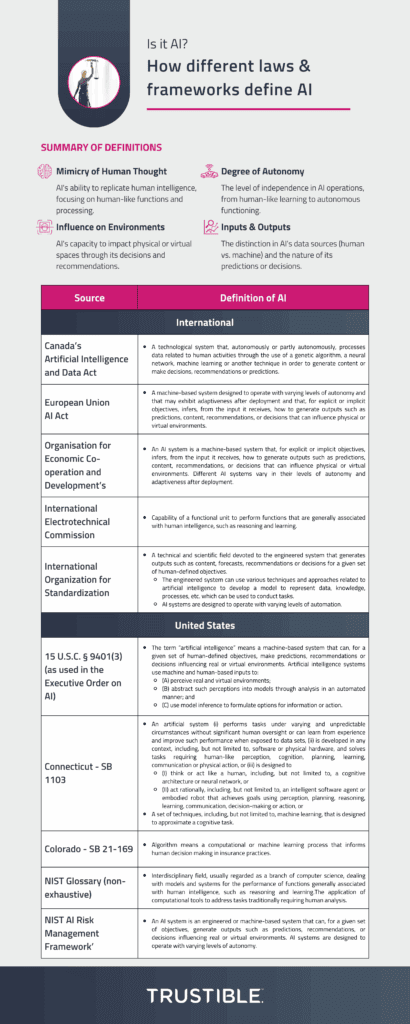
There is no universal legal definition of artificial intelligence. And for governance teams, that gap is the whole problem. A system that triggers compliance obligations under the EU AI Act may fall outside scope under Connecticut’s SB 1103. A risk scoring tool that qualifies as “AI” under the OECD definition may not meet the autonomy […]
Trustible Announces Participation in Department of Commerce Consortium Dedicated to AI Safety
Trustible will be one of the leading AI stakeholders to help advance the development and deployment of safe, trustworthy AI under new U.S. Government safety institute (Washington, DC) – On February 8, 2024, Trustible announced that it joined some of the nation’s leading artificial intelligence (AI) stakeholders to participate in a Department of Commerce initiative to […]
2023 in Review: A State-by-State Look at AI Regulations
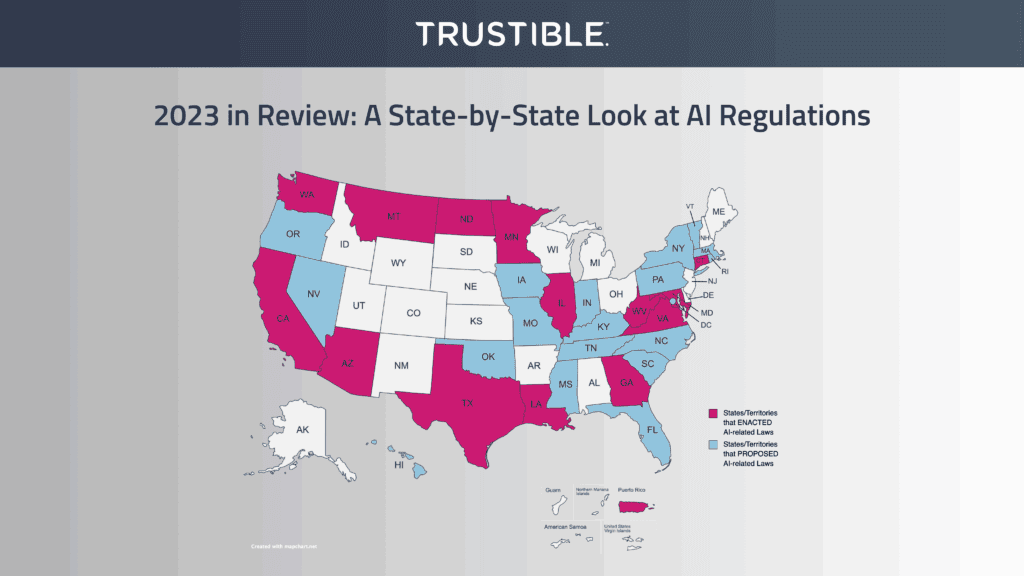
In November 2022, Chat GPT brought the AI revolution straight into the hands of everyday consumers. However, if 2022 launched the proliferation and democratization of AI technology, 2023 can be remembered as the year in which policymakers tried to reign in AI. In the U.S., every branch of the federal government has weighed in on […]
Life After the Rite Aid Order: A Discussion on How the FTC is Shaking Up AI
AI incidents can have major implications for companies looking to develop and deploy AI. Oftentimes, organizations can be financially or reputationally harmed if the AI system performs harmful or unintended actions impacting people – furthering the need for hashtag #AIgovernance. The American drugstore chain RITE AID was recently banned by the Federal Trade Commission (FTC) from using AI facial recognition […]