
Everything you need to know about the NY DFS Insurance Circular Letter No. 7
On July 11, 2024, the New York Department of Financial Services (NY DFS) released its final circular letter on the use of external consumer data and information sources (ECDIS), AI systems, and other predictive models in underwriting and pricing insurance policies and annuity contracts. A circular letter is not a regulation per se, but rather a formalized interpretation of existing laws and regulations by the NY DFS. The finalized guidance comes after the NY DFS sought input on its proposed circular letter, which was published in January 2024.
AI Policy Series 3: Drafting Your Public AI Principles Policy
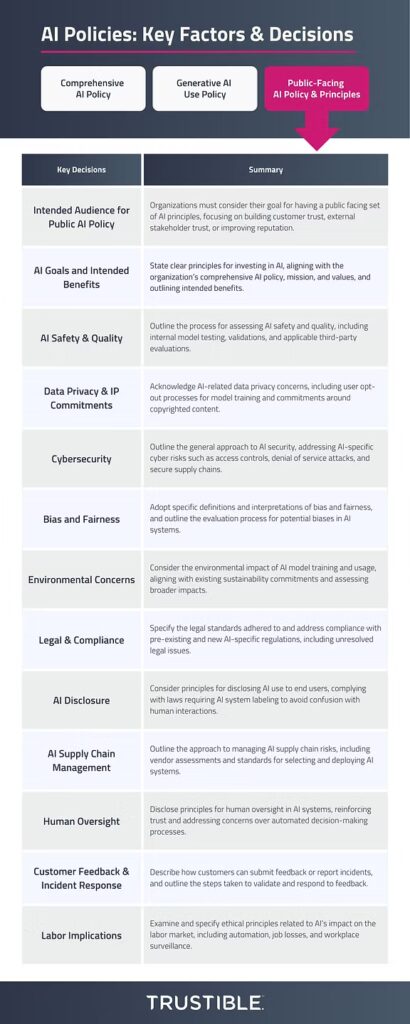
In our final blog post of this AI Policy series (see Comprehensive AI Policy and AI Use Policy guidance posts here), we want to explore what organizations should make available to the public about their use of AI. According to recent research by Pew, 52 percent of Americans feel more concerned than excited by AI. This data demonstrates that, while organizations may understand or realize the value of AI, their users and customers may harbor some skepticism. Policymakers and large AI companies have sought to address public concerns, albeit in their own ways.
AI Policy Series 2: Drafting Your AI Use Policy
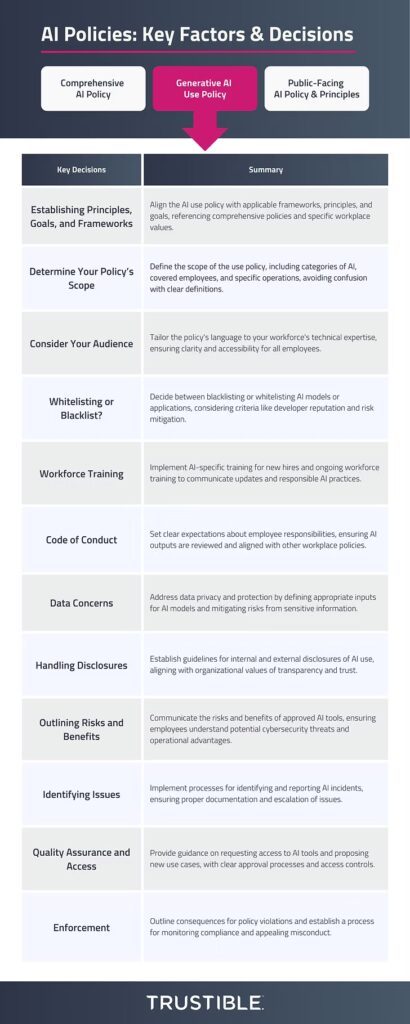
In this series’ first blog post, we broke down AI policies into 3 categories: 1) a comprehensive organizational AI policy that includes organizational principles, roles and processes, 2) an AI use policy that outlines what kinds of tools and use cases are allowed, as well as what precautions employees must take when using them, and 3) a public facing AI policy that outlines core ethical principles the organization adopts, as well as their stance on key AI policy stances. In this second blog post on AI policies, we want to explore critical decisions and factors that organizations should consider as they draft their AI use policy.
AI Policy Series 1: Drafting Your Comprehensive AI Policy
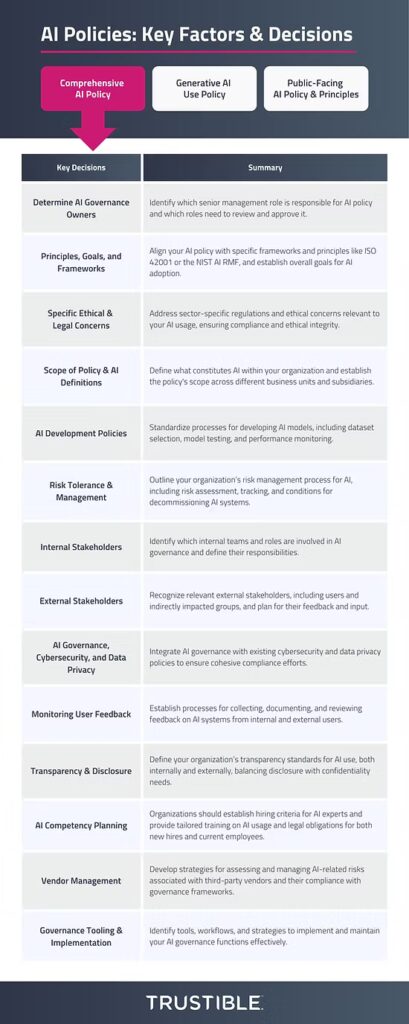
As organizations increase their adoption of AI, governance leaders are looking to put in place policies that ensure their AI deployment aligns with their organization’s principles, complies with regulatory standards, and mitigates potential risks. But where to start in developing your policies can oftentimes be overwhelming. Let’s start with some important context. AI Policies break […]
AI Policy Series 1: Drafting Your Comprehensive AI Policy
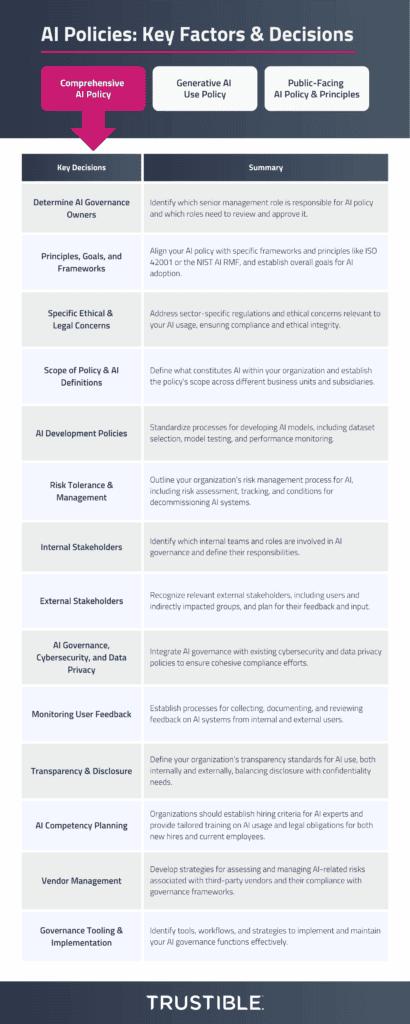
As organizations increase their adoption of AI, governance leaders are looking to put in place policies that ensure their AI deployment aligns with their organization’s principles, complies with regulatory standards, and mitigates potential risks. But where to start in developing your policies can oftentimes be overwhelming.
A Framework for Measuring the Benefits of AI
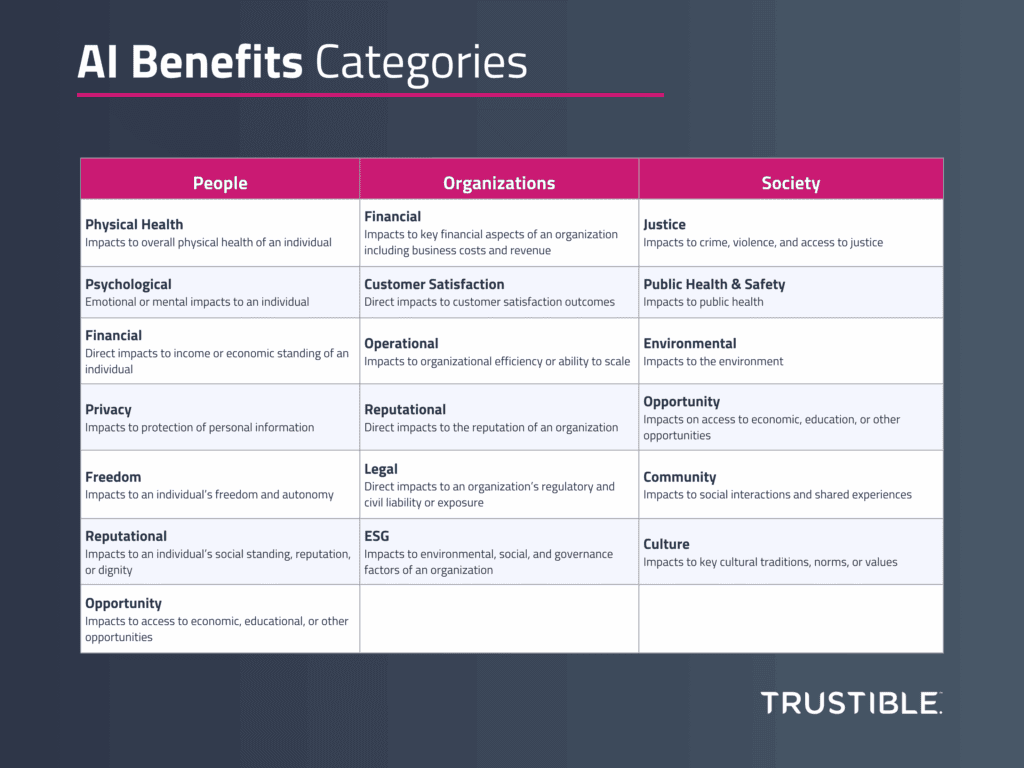
Introduction Significant research has been invested in studying AI risks, a response to the rapid pace of deployment of highly capable AI models across a wide variety of use cases. Over the last year, governments around the world have established AI Safety institutes tasked with developing methodologies to assess the impact and probability of various […]
Trustible Announces New Model Transparency Ratings to Enhance AI Model Risk Evaluation
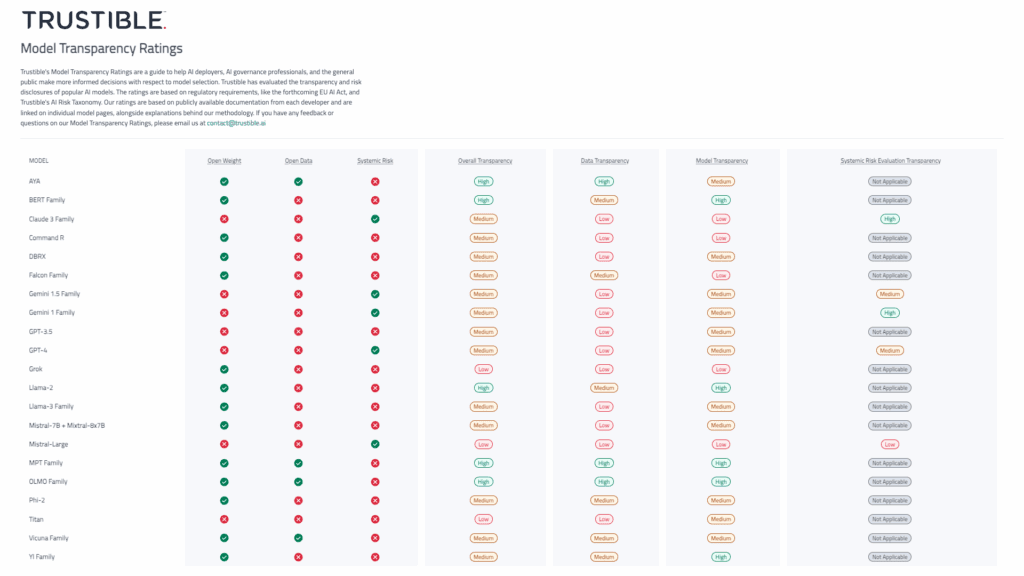
Organizational leaders are looking to better understand what AI models may be best fit for a given use case. However, limited public transparency on these systems makes this evaluation difficult.
In response to the rapid development and deployment of general-purpose AI (GPAI) models, Trustible is proud to introduce its research on Model Transparency Ratings – offering a comprehensive assessment of transparency disclosures of the top 21 Large Language Models (LLMs).
Inside Trustible’s Methodology for Model Transparency Ratings
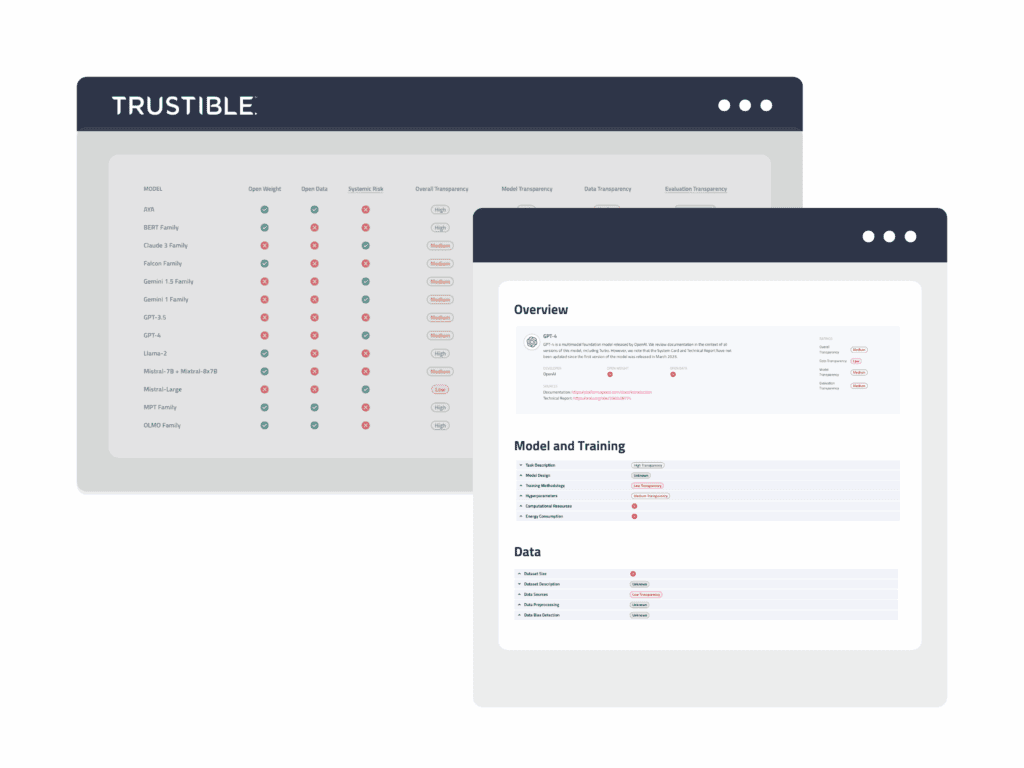
The speed at which new general purpose AI (GPAI) models are being developed is making it difficult for organizations to select which model to use for a given AI use case. While a model’s performance on task benchmarks, deployment model, and cost are primarily used, other factors, including the data sources, ethical design decisions, and regulatory risks of a model must be accounted for as well. These considerations cannot be inferred from a model’s performance on a benchmark, but are necessary to understand whether using a specific model is appropriate for a given task or legal to use within a jurisdiction.
Why AI Governance is going to get a lot harder
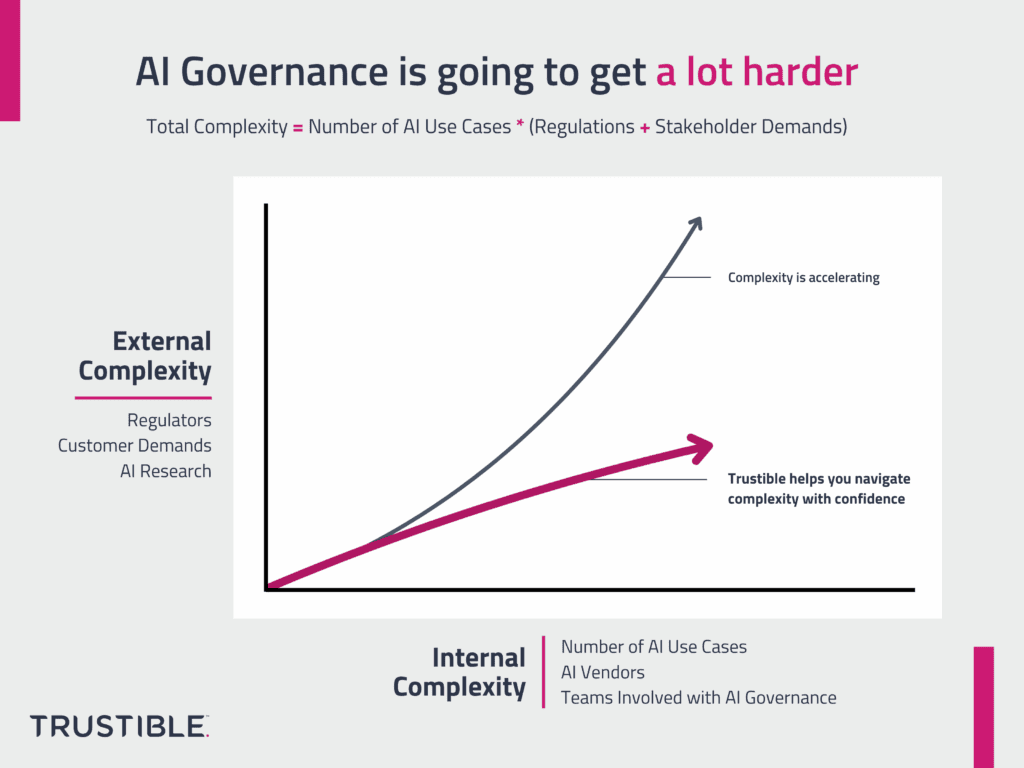
AI Governance is hard as it involves collaboration across multiple teams and an understanding of a highly complex technology and its supply chains. It’s about to get even harder. The complexity of AI governance is growing along 2 different dimensions at the same time – both of them are poised to accelerate in the coming […]