
AI Is Rewriting the Rules of Third-Party Risk
Vendor AI risk is a fast-growing blind spot in the enterprise AI portfolio. 70% of organizations are still building out how they evaluate it, even as 80% of enterprise software vendors are embedding AI into products already running across the business. The challenge is that AI vendors behave differently from what most evaluation processes were […]
Agentic AI vs. AI Agents: What Governance Teams Need to Know
Agentic AI and AI agents are not the same thing. The terms get used interchangeably, but they describe meaningfully different levels of autonomy, and from a governance standpoint, that difference is crucial. Agentic AI is human-triggered: a person initiates the task, the AI decides how to execute it, and a human reviews the result. AI […]
A Governance Framework for Agentic AI
AI governance has always been about reviewing outputs before anything consequential happens. Agentic AI changes that. These systems don’t just generate content, they take action. They call APIs, execute code, send messages, and interact with software on their own. The human checkpoint that traditional governance relied on is no longer guaranteed. Most organizations already have […]
A Pragmatic Blueprint for AI Regulation
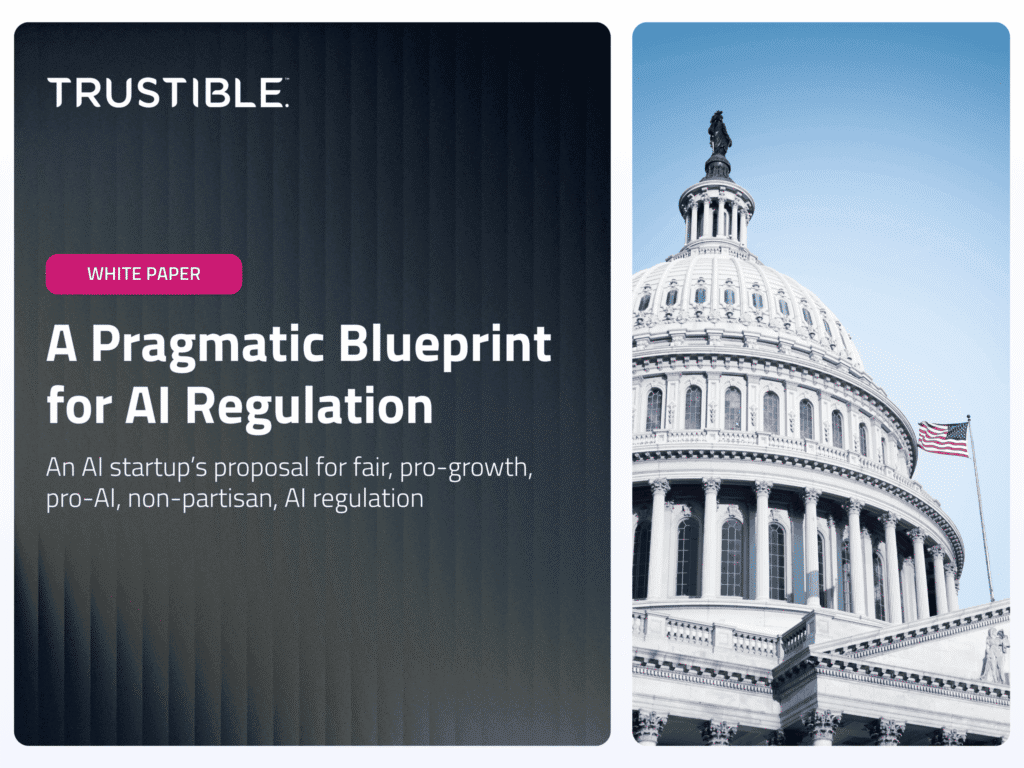
An AI startup’s proposal for fair, pro-growth, pro-AI, non-partisan, AI regulation AI is one of the most transformative technologies of the century, with the potential to accelerate scientific research, improve healthcare outcomes, and help small businesses compete with larger enterprises. The United States currently leads the world in AI development. Yet despite this leadership, a […]
5 AI Governance Trends Heading into 2026
AI has moved from experimental pilots to systems that shape real-world decisions, customer interactions, and mission outcomes. Organizations across sectors, including financial services, healthcare, insurance, retail, and the public sector, now depend on AI to run core operations and deliver better experiences. And their enthusiasm to adopt the technology responsibly is also growing.
AI Governance Triggers: When to Act and Why It Matters
The rapid evolution of artificial intelligence—with continuous advancements in models, policies, and regulations—presents a growing challenge for AI governance teams. Organizations often struggle to determine when governance intervention is necessary in order to balance risk oversight without imposing excessive compliance burdens. This eBook introduces the concept of “AI Governance Triggers” to provide clarity on the specific AI model events that should prompt governance activities.
Enhancing the Effectiveness of AI Governance Committees
Organizations are increasingly deploying artificial intelligence (AI) systems to drive innovation and gain competitive advantages. Effective AI governance is crucial for ensuring these technologies are used ethically, comply with regulations, and align with organizational values and goals. However, as the use of AI and AI regulations become more pervasive, so does the complexity of managing these technologies responsibly.
Analysis – How Trustible Helps Organizations Comply With The EU AI Act
The EU AI Act sets a global precedent in AI regulation, emphasizing human rights in AI development and implementation of AI systems. While the eventual law will directly apply to EU countries, its extraterritorial reach will impact global businesses in profound ways. Global businesses producing AI-related applications or services that either impact EU citizens or supply EU-based companies will be responsible for complying with the EU AI Act. Failure to comply with the Act can result in fines up to 7% of global turnover or €35m for major violations, with lower penalties for SMEs and startups.
Analysis – Mapping the Requirements of NIST AI RMF, ISO 42001, and the EU AI Act
Navigating the evolving and complex landscape for AI governance requirements can be a real challenge for organizations. Previously, Trustible created this comprehensive cheat sheet comparing three important compliance frameworks: the NIST AI Risk Management Framework, ISO 42001, and the EU AI Act. This easy to understand visual maps the similarities and differences between these frameworks, […]