
5 Leading AI Governance Frameworks Every Organization Should Know
Most enterprise organizations don’t face one AI governance framework. They face several simultaneously, each with different requirements, different jurisdictions, and different documentation obligations. This piece is for the compliance and risk professionals who need to understand which frameworks apply to their organization and how to govern across all of them without building separate programs for […]
AI Governance Frameworks: NIST AI RMF, EU AI Act, and ISO 42001 Compared

The EU AI Act, NIST AI RMF, and ISO 42001 share enough common ground that one governance program can satisfy all three simultaneously. That’s the finding we see consistently across enterprise implementations: the overlap between these frameworks is substantial enough to eliminate most duplicated work, if the program is designed around shared controls from the […]
Healthcare Regulation of AI: A Comprehensive Overview
AI in healthcare isn’t starting from a regulatory vacuum. It’s starting from an environment that already treats digital tools as safety‑critical: medical device rules, clinical trial regulations, GxP controls, HIPAA and GDPR, and payer oversight all assume that failing systems can directly harm patients or distort evidence. That makes healthcare one of the few sectors where AI is being plugged into dense, pre‑existing regulatory schemas rather than waiting for AI‑specific laws to catch up.
Everything You Need to Know about California’s New AI Laws

The California legislature has concluded another AI-inspired legislative session, and Governor Gavin Newsom has signed (or vetoed) bills that will have new impacts on the AI ecosystem. By our analysis, California now leads U.S. states in rolling out the most comprehensive set of targeted AI regulations in the country — but now what? The dominant […]
Should the EU “Stop the Clock” on the AI Act?

The European Union (EU) AI Act became effective in August 2024, after years of negotiations (and some drama). Since entering into force, the AI Act’s implementation has been somewhat bumpy. The initial set of obligations for general-purpose AI (GPAI) providers took effect in August 2025 but the voluntary Code of Practice faced multiple drafting delays. The finalized version was released with less than a month to go before GPAI providers needed to comply with the law.
Introducing Trustible’s New US Insurance AI Framework: Simplifying AI Compliance for Insurers
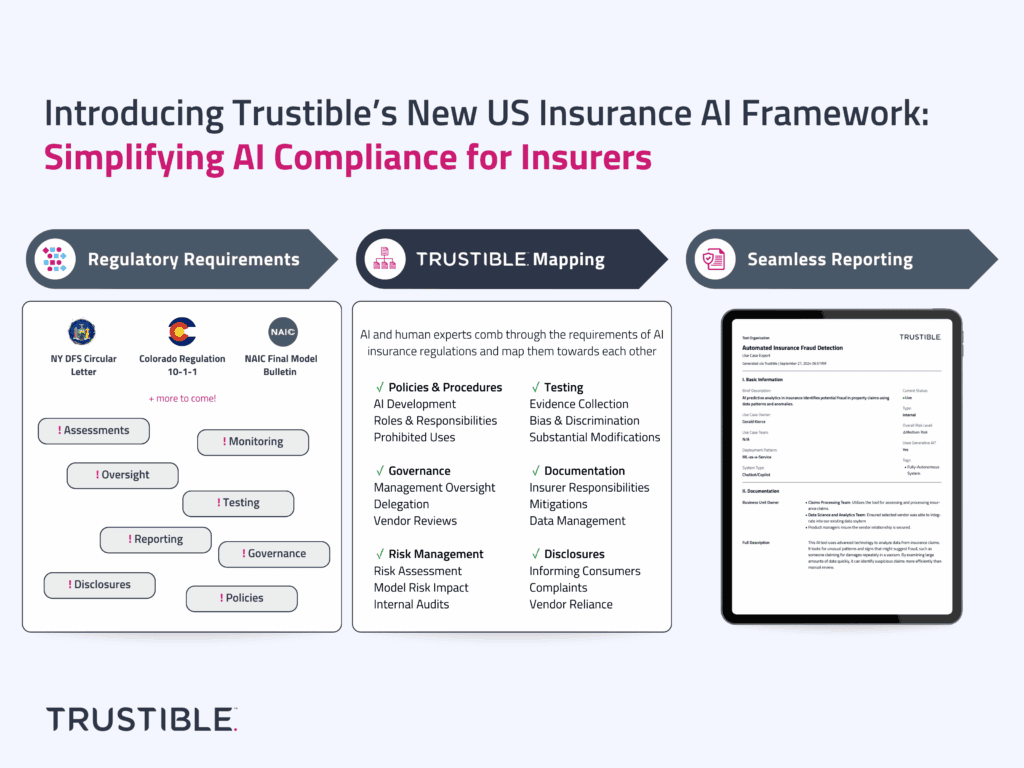
At Trustible, we understand the challenges insurers face in navigating the evolving AI regulatory landscape, particularly at the state-level in the U.S. That’s why we’re excited to introduce the Trustible US Insurance AI Framework, designed to streamline compliance by synthesizing the latest insurance AI regulations into one comprehensive, easy-to-comply with framework embedded in our platform.
Everything you need to know about the NY DFS Insurance Circular Letter No. 7
On July 11, 2024, the New York Department of Financial Services (NY DFS) released its final circular letter on the use of external consumer data and information sources (ECDIS), AI systems, and other predictive models in underwriting and pricing insurance policies and annuity contracts. A circular letter is not a regulation per se, but rather a formalized interpretation of existing laws and regulations by the NY DFS. The finalized guidance comes after the NY DFS sought input on its proposed circular letter, which was published in January 2024.
2023 in Review: A State-by-State Look at AI Regulations
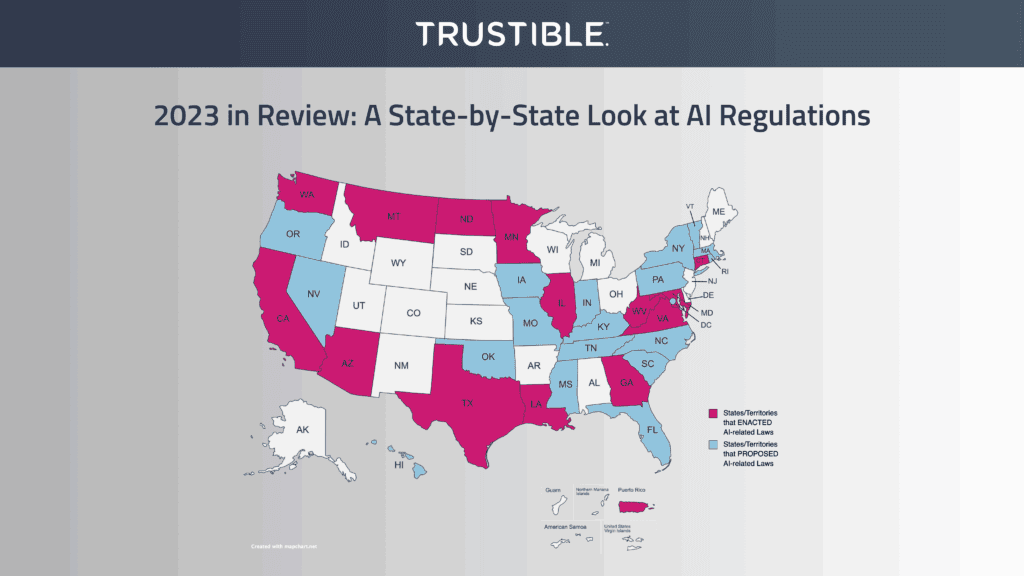
In November 2022, Chat GPT brought the AI revolution straight into the hands of everyday consumers. However, if 2022 launched the proliferation and democratization of AI technology, 2023 can be remembered as the year in which policymakers tried to reign in AI. In the U.S., every branch of the federal government has weighed in on […]
The EU AI Act Should Be A Wake-Up Call for American Companies
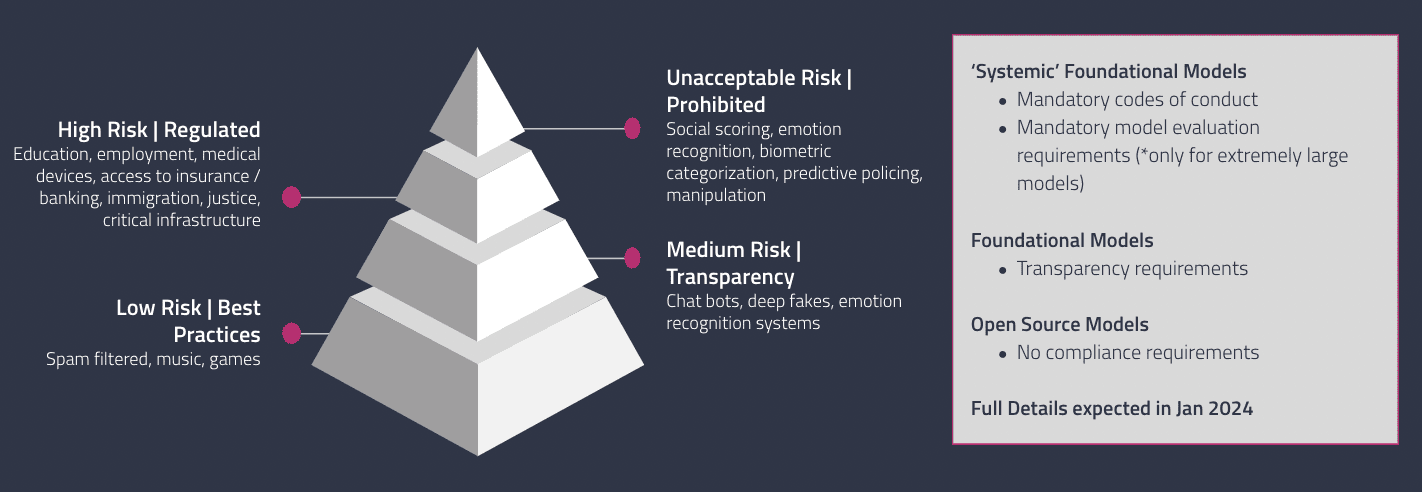
On December 9, 2023, European Union (EU) policymakers reached an agreement on the proposed Artificial Intelligence (AI) Act, which sets the stage for the EU to pass the AI Act as early as January 2024. The impending vote on the compromise legislation marks a significant development in the global AI regulatory landscape; one that American […]