
Analysis – How Trustible Helps Organizations Comply With The EU AI Act
The EU AI Act sets a global precedent in AI regulation, emphasizing human rights in AI development and implementation of AI systems. While the eventual law will directly apply to EU countries, its extraterritorial reach will impact global businesses in profound ways. Global businesses producing AI-related applications or services that either impact EU citizens or supply EU-based companies will be responsible for complying with the EU AI Act. Failure to comply with the Act can result in fines up to 7% of global turnover or €35m for major violations, with lower penalties for SMEs and startups.
Product Launch: Introducing ISO 42001
Today, we’re excited to announce that we are now offering customers access to ISO 42001 Standard within the Trustible platform – becoming the first AI governance company to offer the standard on its platform. ISO 42001 is positioned to be the first global auditable standard designed to foster trustworthiness in AI systems by setting a […]
Is it AI? How different laws & frameworks define AI
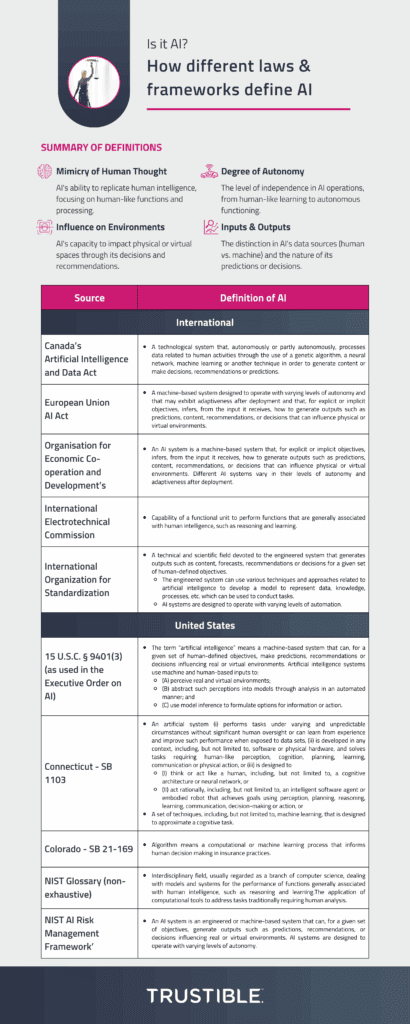
There is no universal legal definition of artificial intelligence. And for governance teams, that gap is the whole problem. A system that triggers compliance obligations under the EU AI Act may fall outside scope under Connecticut’s SB 1103. A risk scoring tool that qualifies as “AI” under the OECD definition may not meet the autonomy […]
Everything you need to know about the NIST AI Risk Management Framework

What is the NIST AI RMF? The National Institute of Standards and Technology (NIST) Artificial Intelligence Risk Management Framework is a voluntary framework released in 2023 that helps organizations identify and manage the risks associated with development and deployment of Artificial Intelligence. It is similar in its intent and structure to the NIST Cybersecurity Framework […]